


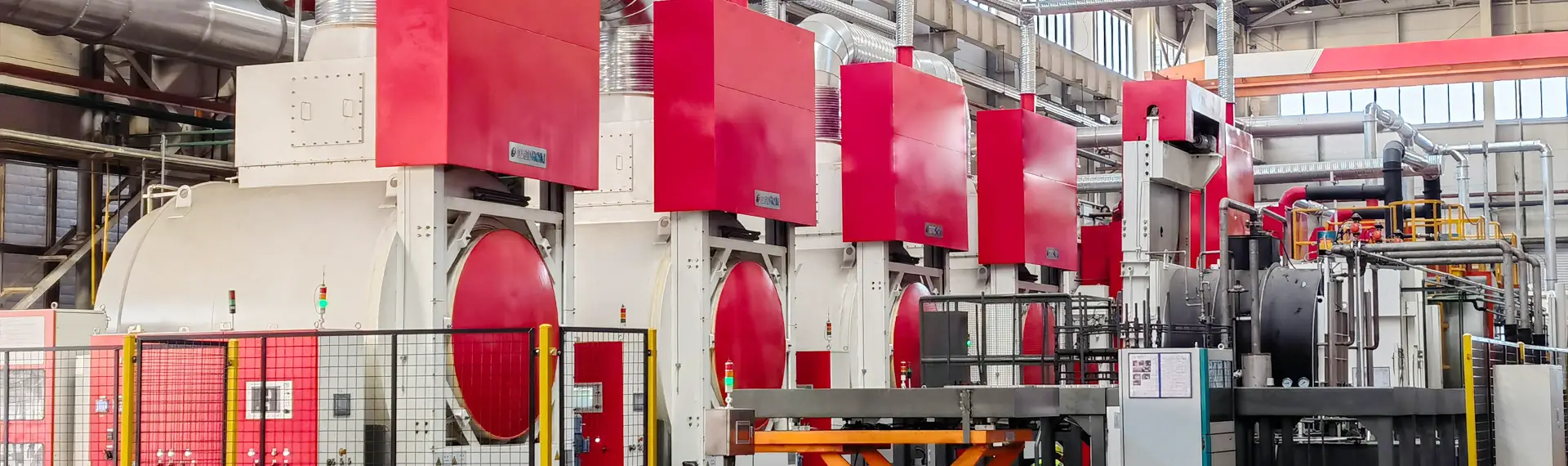
Product display
PRODUCTS
PRODUCTS
Strong Products
Founded in 2000, focusing on metal material modification, metal material development and application and shape control processing services, intelligent heat treatment equipment, robots and intelligent equipment manufacturing.
Bright annealing line for horizontal looper (electric heated)
Bright annealing line for horizontal looper (electric heated) Advantage: very stable quality Scope of application: architectural decoration industry, civil tools, tableware, knives, etc.
View Details
Ammonia Cracker (100~180 cubic)
Decomposed the ammonia into 75%H2 + 25%N2 as the reductive gas. It has been widely applied in the industry metal bright heat treatment, powder metallurgy agglomeration, metallicmaterial gas sheilding welding, bright demagnetization of magnetic material, electric, brazing and soldering, etc. Gas cracker: 10-180m³/h Max. Temp.: 850C Power: 15 - 220KW
View Details
Ammonia Cracker (20 ~ 100 cubic)
Decomposed the ammonia into 75%H2 + 25%N2 as the reductive gas. It has been widely applied in the industry metal bright heat treatment, powder metallurgy agglomeration, metallicmaterial gas sheilding welding, bright demagnetization of magnetic material, electric, brazing and soldering, etc.
View Details
Ammonia decomposition device used in small laboratory
Small ammonia decomposing furnace, suitable for laboratory atmosphere furnace. The gas production capacity is 1 ~ 5m³ / h, which is precise and controllable.
View Details
Horizontal looper stainless steel strip bright annealing line
Horizontal looper stainless steel strip bright annealing line As the key equipment of transmission, looper mainly stores stainless steel strip to ensure the continuous production of the unit at normal process speed. Through the alternating operation of the looper's "filling" and "releasing" actions, the unit can keep stable production. The horizontal looper, as a common arrangement in the operation of continuous units, has a relatively simple structure and does not need a large workshop, but it has a long length and a large floor area. It is generally used in combination with the horizontal furnace. In design, the inlet horizontal loop is often arranged under the horizontal furnace, and the manufacturing cost of horizontal loop is lower than that of vertical loop.
View Details
Bright annealing line for Stainless steel tube
Austenitic stainless steel is softened by solution treatment. Generally, the stainless steel pipe is heated to 950-1150 ℃ for a period of time, so that carbides and various alloy elements are fully and evenly dissolved in austenite, and then rapidly quenched for cooling. Carbon and other alloy elements are too late to precipitate to obtain pure austenite structure, which is called solution treatment. There are three functions of solution treatment: 1. It is particularly important for raw materials to make the structure and composition of steel pipes uniform, because the rolling temperature and cooling speed of each section of hot-rolled wire rod are different, resulting in different structure. At high temperature, the atom activity is intensified, σ phase dissolves, chemical composition tends to be uniform, and uniform single-phase structure is obtained after rapid cooling. 2. Eliminate work-hardening to facilitate continuous cold work. Through solution treatment, the distorted lattice is restored, the elongated and broken grains are recrystallized, the internal stress is eliminated, the tensile strength of the steel tube is decreased, and the elongation is increased. 3. Restore the inherent corrosion resistance of stainless steel. Due to the carbide precipitation and lattice defect caused by cold working, the corrosion resistance of stainless steel decreased. After solution treatment, the corrosion resistance of the steel pipe is restored to a proper state. For stainless steel pipes, the three elements of solution treatment are temperature, heat preservation time and cooling speed. The solution temperature is mainly determined by chemical composition. Generally speaking, the solid solution temperature of alloy with many kinds and high content should be increased accordingly. Especially for the steel with high content of manganese, molybdenum, nickel and silicon, the softening effect can be achieved only by raising the solution temperature and making it fully dissolved. However, for the stabilized steel, such as 1Cr18Ni9Ti, the carbide of the stabilized element is fully dissolved in austenite when the solution temperature is high, and precipitates at the grain boundary in the form of Cr23C6 in the subsequent cooling, resulting in intergranular corrosion. In order to keep the carbide (TiC and Nbc) of the stabilized element from decomposition and solid solution, the lower limit of solid solution temperature is generally adopted. Stainless steel as the saying goes is not easy to rust steel, in fact, there is a part of stainless steel, which contains both rust resistance and acid resistance (corrosion resistance). Stainless steel's rust resistance and corrosion resistance are due to the formation of chromium rich oxide film (passivation film) on its surface. Among them, rust resistance and corrosion resistance are relative. The results show that steel in weak medium such as atmosphere, water and oxidizing medium such as nitric acid, which corrosion resistance will enhance with the increase of chromium content in steel, and is in a positive proportion. When the content of chromium reaches a certain proportion, the corrosion resistance of steel changes abruptly, that is, from easy to not easy to rust, from non corrosion to corrosion resistance.
View Details
Conveyor Belt Furnace (Guanghui Furnace)
The Conveyor Belt Furnace (also known as Guanghui Furnace) of STRONG TECHNOLOGY, with its unique design concept, simple equipment, reasonable structure, bridge type placement of workpieces, internal furnace pressure makes air not easy to enter;
View Details
The Main applications of Conveyor Belt Furnace: Hardware hardening, carburizing, tempering, brazing, sintering, quenching and cooling
View Details
Hotline
Business docking E-mail
Company Address
No.30, Shizhou Industrial Zone, Chencun Town, Shunde District, Foshan City, Guangdong Province